Sunday, June 15, 2014

Latest article: Turkey Vultures on Nantucket

This week’s topic came up while talking with friends about trends on island that might be fun to write about. They mentioned that they remember when no Turkey Vultures were present on island and how prolific they are now. Doesn’t everyone have carrion eater conversations during dinner? On Nantucket that may be more common, our food is so good even talk of road kill doesn’t deter us from eating. And my friends were right, Turkey Vultures on Nantucket are a relatively recent immigrant, lured north by warming weather and into urban and semi urban areas with the growth of streets and highways. Along with crows, they are frequently encountered on our roads cleaning up road kill created when wildlife travel meets car travel. Both deserve their own column because they are fascinating birds, so let’s learn more about Turkey Vultures, “Turkey Buzzards” or TVs as they are often called for shorthand. I’ll also capitalize Turkey Vulture after reading a few articles which insist that is the way to do it properly. On May 25th, the Sunday morning bird walk (which resume in September) found 12 Turkey Vultures just in the Crooked Road and Cliff Road area (checklist athttp://ebird.org/ebird/view/checklist?subID=S18551931). On any given day on Nantucket there are likely several dozen flying around.
The Turkey Vulture’s Latin name, Cathartes aura, comes from the Greek “katharsis” meaning to purify or to cleanse and “aura” Latinized from the Native Mexican word for the bird, “auroura”. The Turkey Vulture was first formally described by Linnaeus as Vultur aura in his Systema Naturae in 1758; “vulture” is derived from the Latin word “vultures”, meaning “tearer” which alludes to their feeding habits.Turkey Vultures are New World Vultures, found in the Americas. Though both are similar in appearance and have similar ecological roles, the New World and Old World Vultures evolved from different ancestors in different parts of the world. Just how different the two are is currently under debate, with some earlier authorities suggesting that the New World vultures are more closely related to storks. Most authorities now place Turkey Vultures in their own order, Cathartiformes although others, especially in South America, prefer placing them in the Order Incertae sedis, or Falconiformes. Riveting. Keep reading, TVs do many cool things.
The Turkey Vulture breeds from southern British Columbia, central Saskatchewan, the Great Lakes, and New Hampshire southward. It winters in the Southwest, and in East northward to southern New Englandhttp://birds.audubon.org/birds/turkey-vulture retrieved June 1st, 2014. “Turkey vultures, so named for their featherless headed resemblance to Wild Turkeys and their habit of sitting on the ground to eat, are migratory in nature but winter as far north as Connecticut. They appear in Massachusetts in late February and slowly make their way north for a summer spent wavering over farm fields and eating carrion.” http://thedailybirdnewengland.blogspot.com/2011/02/signs-of-spring-vulture.html
Both male and female TVs are very similar in appearance exhibiting minimal sexual dimorphism with the only differences being that the female is slightly larger and the males have a wattled (fleshly and wrinkly) look. Their bodies are very dark brown, nearly black and they have the characteristic bald, pink heads with a sharp, whitish, hook-tipped bill. Their legs and feet are reddish pink (often stained white, we’ll learn why soon!) and their wings are two-toned from below with dark inner wings and paler almost silvery outer wings. The juvenile have grayish heads and feet. They weigh in average about 64 ounces (almost 4 pounds or roughly 2 kilograms) and vary in length (height) from 24-32 inches with a total wingspan of 63-71 inches,
Turkey Vulture’s have a semicircular pattern of whitish to greenish papillae or warts around their eyes that varies from one individual to another. These papillae may be caused by bacterial infections resulting from constant exposure to rotting meat. This gives them a “Mr. Burns” look if you remember your Simpson’s characters. The nasal septum, a thin partition between the two nostrils, has a hole in it (this is true of all New World vultures), so an observer can look right through a Turkey Vulture’s nostrils. That means that “a Turkey Vulture, should it be so inclined, can wear a nose ring.” I wish I had thought of that line, but that is from http://www.wingmasters.net/tvulture.htm retrieved June 1st, 2014.
The Turkey Vulture’s return to New England is a sure sign that things will get warmer. Like Storks, the Turkey Vulture often defecates on its own legs, using the evaporation of the water in the feces and/or urine to cool itself, a process known asurohidrosis (sounds lovely). Pooping on itself cools the blood vessels in the unfeathered tarsi and feet, and causes white uric acid to streak the legs. The Turkey Vulture has few natural predators. Adult, immature and fledging vultures may fall prey to Golden Eagles, Bald Eagles and Great Horned Owls, while eggs and nestlings may be preyed on by mammals such as raccoons, opossum and foxes (which are not found on Nantucket). Its primary form of defense is regurgitating semi-digested meat, which deters most creatures intent on raiding a vulture nest. Even fledglings can projectile vomit in order to protect themselves. The Turkey Vulture lives up to 16 years in the wild and 30+ years in captivity (derived fromhttp://en.wikipedia.org/wiki/Turkey_vulture retrieved June 1st, 2014.)
Often people will mistake a Turkey Vulture for a hawk. Many raptors exhibit the same kind of thermal flying or circling behavior, but unlike an Eagle or Red-Tail Hawk, TVs have a wobbly look as they circle. They can also be identified by the V pattern (dihedral) they make while flying and by the fact that their feather tips are spread out almost like fingers. In flight the outermost six primary feathers are splayed open like the curved fingers of a hand to give the bird more lift. Because these primary feathers can be moved individually, this species has superb flight control. A turkey vulture can stay aloft at very slow speeds without stalling and falling. They prefer to ride thermals and are less likely to be seen on windless days. They are also bigger than other raptors except for Eagles and Condors.
Turkey Vultures are relative new comers to upper New England. They were seen as occasional migrants for decades but did not hang around to nest until recently. “In 1930 a Turkey Vulture nest discovered in Connecticut marked the species’ first confirmed nesting in New England. Turkey Vultures nested in Massachusetts for the first time in 1954, and now they are firmly established in the state as both breeding birds and migrants. By the early 1970s they had pushed into New Hampshire and by the early 1980s they could be seen in Maine.” From http://www.wingmasters.net/tvulture.htmretrieved June 1st, 2014.)
Designed to eat carrion (dead things) TVs have an acute sense of smell and can reportedly smell day old meat from several miles away. A lot of research has been done to evaluate the acuity of a Vulture’s sense of smell . John James Audubon himself had difficulty verifying their abilities because he used carrion that was too far gone to interest a Turkey Vulture. Ecologist David Houston, working in the tropics, hid chicken carcasses in varying stages of decay. His research showed that turkey vultures cannot detect freshly-killed carcasses by smell. By the second or third day, as the meat begins to rot, the birds can, and do, find their way to the carcasses. However, by the fourth day, when the chickens were in an advanced state of decay and therefore very smelly, turkey vultures rarely showed any interest. Houston concluded that by that point there would be such a high level of microtoxins present in the putrescent meat that it would be dangerous to eat even for a vulture.
This is not to say that Turkey Vultures hunt exclusively by smell. They use an efficient combination of sight and smell. This species typically soars about 200 feet in the air or even lower, cruising just above the treetops. At that height the birds can smell a carcass, but not higher. On these searching flights the vultures are also using their very sharp eyesight to spot food. Once it is sighted, another vulture strategy comes into play. These birds watch each other as they look for food. When food is sighted, the finder wins a prize (just kidding, well they do get to eat) then circles above it for some time, alerting the other vultures in the vicinity to the presence of a meal. When one bird drops down, they all drop. Last one to the carcass is a rotten egg, or at least smells like one.
Fortunately, the current population of Turkey Vultures which has protected status as a migratory bird now exceeds five million birds. Most populations of this adaptable species appear to be thriving. The vulture’s beneficial role as a scavenger is recognized, and the species is not persecuted. Unfortunately, this was not always the case. In the past, Turkey Vultures were shot because ranchers and farmers mistakenly believed that they spread diseases and contaminated watering holes for livestock, although there is no evidence to substantiate this claim.
Last but not least there are many legends and myths and stories associated with Turkey Vultures. For instance, I found this story: “In American Indian mythology, it was believed that the sun was originally much closer to the earth and was in danger of burning it up. First the fox unsuccessfully tried to pull the sun away in its mouth, accounting for the black inside of its mouth. Next the opossum unsuccessfully tried to pull the sun away with its tail, accounting for the hairless tail. Finally a beautiful fully feathered vulture successfully pushed the sun away from the earth with its head, thus becoming bald for eternity” from http://www.pauldfrost.co.uk/intro_v.html retrieved June 1st, 2014. Not only do they keep our roads clean, but they also managed to save the world, good for them. This article just covered the tip of the iceberg on TVs I encourage you to learn more. This site is an excellent source of information on both Turkey Vultures and Black Vultures: http://www.wingmasters.net/tvulture.htm. I also really appreciated the Hawk Mountain info athttp://www.hawkmountain.org/raptorpedia/hawks-at-hawk-mountain/hawk-species-at-hawk-mountain/turkey-vulture/page.aspx?id=644. “Notes on the Taxonomy of Vultures” by American Ornithologist Dean Amadon can be found at (http://sora.unm.edu/sites/default/files/journals/condor/v079n04/p0413-p0416.pdf), Upon his death, his estate created a grant for raptor research which can be found at http://www.raptorresearchfoundation.org/grants-and-awards/grants/dean-amadon-grant

and more?! vultures may limit disease http://www.bbc.com/future/story/20140210-vultures-halting-killer-diseases

Tuesday, November 5, 2013

Food for Thought: October 17, 2013, "News from the U-MASS Boston Nantuck...

Just in case you haven't heard me blather on lately; my Food for Thought lecture 2 weeks ago at the Nantucket Historical Association's Brown Bag Lunch Series entitled "What's Up at the UMass Boston Nantucket Field Station". Thanks to the NHA for making this available and check out all their (much more interesting) speakers like Nat Philbrick and Greg Skomal and many more.

http://www.youtube.com/v/A-0cdxAFGZc?version=3&list=PLjgJVmnztYsTqYVn_ijBhCGxA5-7DMtGw&autohide=1&showinfo=1&feature=share&autoplay=1&attribution_tag=7GNe8rvzipXWIiPFoWMIag

Wednesday, July 31, 2013

If you are one of the 5 people on the planet who has not seen the latest somewhat controversial article in the August issue of Vanity Fair featuring in the role of the villain/hero (depending on your viewpoint) yours truly; well then here is the link http://www.vanityfair.com/society/2013/08/end-of-malibu-nantucket-erosion

I have written several article on erosion and coastal processes and why coastal banks and beaches are necessary and important parts of our island home. In the next few weeks post them here as I share some of the recent island science and news stories. What to do about seals and erosion, if anything, are the hot topics this summer.

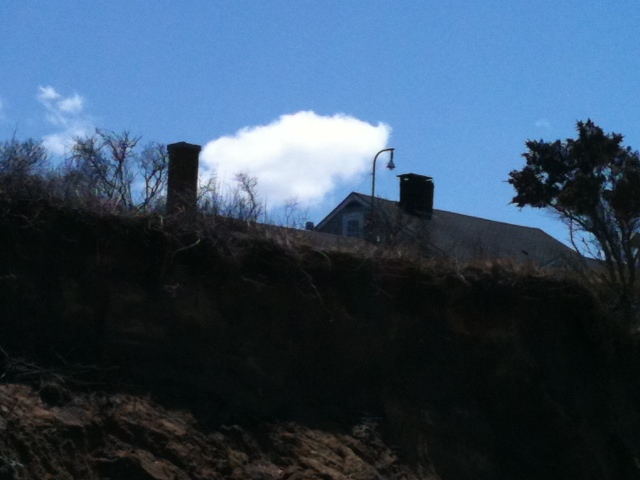
View from beach of eroding coastal bank and our dorm and web cam
The Field Station itself is only 40 feet from an eroding bluff, so we'll be making plans to move our dorm and classroom. For now, it is a wonderful place to see geology exposed (layers of clay, sand, and mud can easily be seen), history exposed (old ships and student experiments are unearthing themselves) and anthropology (middens and Wampanoag points and other relics of the original inhabitats of Nantucket are found frequently on our beach.

Join me in this beach journey,,not your average stroll in the surf but it should be interesting.

Wednesday, July 17, 2013

This weeks article in Yesterday's Island is on eels which have been fished for and used for bass fishing for decades on island.http://yesterdaysisland.com/american-eel/

Friday, June 28, 2013

It's firefly and June bug season on Nantucket and the fireflies are out in force. Check out this article from a few years back that I wrote for Yesterday's Island. As the summer warms up these species are indicators that the 4th of July is right around the corner: http://www.yesterdaysisland.com/archives/science/9.php


Sunday, July 22, 2012

Today I am writing an article for my weekly column in Yesterday's Island (Island Science at http://www.yesterdaysisland.com/) about the recent hysteria over the Great White sharks around the Cape and Islands and commenting on the clearing of the beaches last weekend over what turned out to be sunfish (Mola Mola) which are relatively common here. Here's a link to the past week's news stories:

The Nantucket Field Station has helped to house and support some of the researchers who have been tagging great White Sharks like Dr. Greg Skomal of Shark Week Fame. I have just discovered this site which has a lot of information on what's up in shark news "without the hysteria".

Over the past few years I have written articles in Yesterday's Island about the lumbering sunfish and as I resurrect this blog I thought I would dust one off and revisit why people think "shark!", when in reality it is more likely to be a dolphin, whales, or sunfish.

Oddballs of the sea! 

Thursday, May 19, 2011

wine and aging-sleepless at Logan

well, one of the few good things about missing your connection at Logan from Nantucket due to fog (normal for flights off the Rock) and having a solid 12 hours of quality time to spend at the aiport is that I finally get to catch up on my blog.

My brother kindly got me the newest version of Dragon Speaking Naturally as a Christmas present. Each year he asks me what I'd like (typical family ingrained practicality trait) and I've always wanted to try speech recongition software in order to speed up my writing and spare my wrists from a second set of carpal tunnel surgery.

During the spring, summer and fall, I write a weekly column (1500-2000 words) for Yesterday's Island which is published online and in print on island. Last week's article on wine and aging was my first attempt to use Dragon and I was pleasantly surprised by the ease of use. I was able to speak/type the first 650 words in about 5-10 minutes. I can type about 40-45 words per minute, but I'm not very accurate, so I'll take any help I can get. I haven't had the chance to see how well it works with a lot of noise like a TV program in the background, but I am hoping that I can use it in a variety of ways each week. Like most people, I have my "best" ideas for columns or research or education or whatever in inverse proportion to my distance from a pen and paper, so lately I've taken to carrying around an ancient voice recorder to speak into when the muse strikes. Dragon has a button for transcribing, so my next experiment will be to see how well my static-y recorded voice is transcribed.

This past month, we've been doing twice daily horseshoe crab surveys in the marsh and along the beachfront on the full and new moon cycles and 48 hours before and after each anticipated high tide. Here's an article I wrote two years and many crabs ago. I'll update it soon with some information gleaned from late night surreal surveys.

Monday, February 28, 2011

Weird bone report

Andrew McKenna-Foster, the Natural Science Research and Education Director at the Maria Mitchell Association found this weird bone in their collection a few weeks back. Any guesses as to what it is??


It is very rounded and smooth; no identifying tags or location clues besides being here on Nantucket (which can be a red herring with all the trade and travel initiated by the whalers).

While I was looking around the web for some clues to this mystery, I came upon this site and really liked it, so I thought I would share it with you: http://www.neatorama.com/tag/fossil/

Lots of fun fossils on there, one of my favorites is a member of a family of giant armored turtles called meiolaniid which can be seen at the Smithsonian Natural History museum in DC. If you are ever in the area,  check out some of our greatest national treasures, the various free Smithsonian museums (19 at last count) on the Mall in DC:

Wednesday, February 23, 2011

Pump up the volume

Every morning I have been dragging my sorry butt downstairs to the shop to jog on my treadmill. This morning, our Labradoodle, Swegen, decided his new game would be to toss a tennis ball over, under, on, or around me as I am jogging. I'd like to say  a graceful dance ensued, a pas de deux of human and animal, but in reality, it led to a very quick coda with said dog getting to explore the snow outside on his own. 

Like almost everyone else, I enjoy listening to music while I jog. My treadmill has a TV which if connected would be another way to while away the blocks/miles, and I've tried to listen to comedy podcasts and NPR too, but each time, I tend to do much better listening to music. Once in a blue moon I'll forget my itouch or discover I haven't charged it and find out that I do much more poorly without the inspiration.  Even with a somewhat eclectic and not all that "beat happy" a play list (My Chemical Romance, Weezer, LIVE, Cake, U2, David Bowie, Flaming Lips, Muddy Waters, White Stripes, insert 90s grunge band here) my gait increases from one of a dead sloth to a mildly motivated Galapagos turtle.And as a certified geek, I know there is some science to back that up: http://www.acefitness.org/certifiednewsarticle/805/

“Music is like is a legal drug for athletes,” says Costas Karageorghis, Ph.D., from London’s Brunel University School of Sport and Education, one of the world’s leading authorities on music and exercise. “It can reduce the perception of effort significantly and increase endurance by as much as 15 percent.”

I am not specifically advocating for the following sites, but there are many on the web that let you find a series of songs at a specific beat per Minute (BPM) to help you exercise; try: http://jogtunes.com/ or http://www.runningmusicmix.com/and of course, Lifehackers.

So get out there or in there, keep the dog out of the way or entertained, and enjoy. 

Friday, February 11, 2011

spelling bee, quentin the quahog and a good blog to read

Many people think that there is not much to do on Nantucket in the wintertime; and for islanders, this is what we keep wanting them to think. But, it's not true, in fact, just the opposite. Winter is our time to socialize, to get out and spend time with friends, to take long walks in the Middle Moors, and to do things that make life on "the Rock" special. This is even more important this winter, when travel to "America" has been a bit more challenging.

Tonight, for example- there are at least 3 or more social events happening on island; all of which have the possibility of being uplifting, entertaining, and educational.

1) Sustainable Nantucket presents a screening of the Film "The End of the Line" with a Q&A with local fisherman:  more info at http://www.libraryinsight.com/eventdetails.asp?v=3&jx=nd&lmx=322281
2) one of the many "One Book One Island (OBOI): events this week. A showing of "The Tuskegee Airmen at the African Meeting  House; Len is organizing some music and the readings. http://www.nantucketatheneum.org/programs-events/for-adults/one-book-one-island-2011/
3) our normal Friday night event: trivia night at the Rose and Crown; we usually fill up two 6 person teams (boys and girls ;-)) Our team names are BassAckwards and Clueless; tonight's fun is a benefit for Family Planning and includes raffle items. Every week, almost everyone we knows shows up for trivia for a chance to win cash and bragging rights.

Speaking of bragging rights :-) the Civic League Team (Members include myself and Chris Lohmann and Peter Morrison) won our island Spelling Bee last week which is a benefit for the "Friends of the Nantucket Public Schools ( . Here's a picture of our team with our trophy and t-shirt costumes and a link to the story.  It was a hard fought battle- we have some amazing spellers on island, many of whom study and practice and come back every year (21 teams) and we just barely squeaked by Nantucket Bookworks! Example words: lederhosen, nachtmusik, dachshund, perestroika, knish, schloss, quixote (with the hard pronunciation), philhellenism, sayonara, sarsaparilla (both teams- down to two then, forgot the second "a" out of 4 "a"s, and jipijapa (pronounced "hippy-hopa").

the last two weeks have been full of other OBOI events, potlucks, superbowl parties, long chats in the produce aisle, seeing one another at the high school science fair, and competing in trivia and game nights. Quentin the quahog is our version Punxsutawney Phil. This year he squirted to the left indicating 6 more weeks of winter.

For the next few weeks, the political atmosphere will heat up on island as we prepare for Annual Town Meeting and our yearly elections as well as open a brand new public safety facility. Summertime, we become more serious, work 12-16 hour days, marvel/curse at the increase of population from 15,000 to 60,000 people not counting tourists, and while we enjoy the warmth, we look forward to our "social season".

If you have made it this far in today's entry, please go read and sign up for this excellent blog by my friend and colleague, Dr. Greg Smith! [http://natorder.blogspot.com/].... today's post covers a recent topic currently circulating among island biologists and conservationists concerning feral cats.

Monday, January 3, 2011

New Year's News

Right now I am completely redoing the UMass Boston Nantucket Field station website (http://umb.edu/nantucket    ---- new version live on Friday January 6th). It will be faster, stronger, and capable of leaping tall buildings. I should be able to update it more, just like I hope to update this blog more often.I've had a lot of help with that site and it shows.


Just like many typical Monday after the holidays: we have a very dead whale carcass on the sand on the south side of the island. I think it is kind of beautiful, bleached bone with very old and leathery skin. An observant and helpful beach wlaker reported it and if I get permission to post the pics, I will.

Len's blog has been excellent lately; check it out at http://athomewithmybooks.blogspot.com/
Resolution #7643........ post more often, even if you only have time to post something short. Here is the rest of my New Year's resolution that I posted on Facebook.Note: it sounded better in my head at the time.
________________________________________________________________

my lovely and intelligent friend G *****n (redacted to protect the innocent) asked about resolutions- I am not big on them- but here is my attempt this year:

most days will not be like today (for one thing 8-9 + hours of work makes this harder), but hope to make them more like this everyday. Do 1 thing for each person/entity in your life everyday including yourself. My list for today (1/2 done is)
1. For me- jog/run/walk 2 miles every morning on treadmill- done- bit hard with a wee hangover but I managed- passed the 200 mile mark on the treadmill- goal this year 400 miles
2. for hubby - my part of cleaning the house (1/2), cook dinner (tradition new years day dinner: duck, collard greens, black eyed peas not the band- or maybe the band) and make low sugar choc chip cookies- in progress
3. For dog - nice long walk from mile marker 5 almost to altar rock and back- done and beautiful this morning- did not get accidentally shot by deer hunters a plus
4. for cats - change litter box and order them a new water bowl, extra petting- thankfully they do not need much
5. For field station- meet with birders tonight at 700; organize shop downstairs (day off so only an hour for that - done)
6. For friends - hang out tonight for dinner and drinks at 800 (past Len's bedtime) -done
7. For "Greater good"/world or whomever"- recycle and pass along old clothes I get rid of today to someone who needs them (and has even less fashion sense than me which may be tough) and schedule first urban school trip to field station for 2011- work on blog- hey this is long enough to be my blog entry; even got rid of my old futon
Tada!: My resolution - do something for each of these above as best as I can everyday and don't beat myself up when I can't - should be on resolution list- be less wordy; but I know my limits :-)
 _________________________________________________________________
okay you can wake up now

I don't know if you are like me, but as soon as I list resolutions, I think of about 100 more I should have listed. Honestly, every day should be a new resolution day; like a self referential form of Groundhog's day. Maybe mine newest new one should be to watch "Zombieland" once a week. I am pretty sure I can keep that one.

last but not least- a cute youtube video of polar bears vs. scientific observation cameras (guess who wins)
http://www.youtube.com/watch?v=tT0O2RyxnkY

Thursday, December 9, 2010

Climate Change lecture tonight

Tonight I'll be doing a reprise of my lecture on Climate Change and its relevance for Nantucket.

"What is Climate Change and What Does it Mean for Nantucket?
Thursday, Dec 9. 6:30-8:30pm @ the Greenhound Building (Downtown NRTA bus terminal building near Wilkes Square)


Description: Marine Biogeochemist, Dr. Sarah Oktay, describes the current understanding of climate change science and explores the ways in which Nantucket, both the island and its inhabitants, may be affected.  (No charge)


For about 10 years during my research career in Galveston and in Boston I worked on identifying the sources for organic matter in the ocean using iodine isotopes. [one of several articles from that research, abstract only]: http://tinyurl.com/2a6axrk


I would also recommend you check out this video: "What's the worse that can happen" also known virally as The Most Terrifying Video You'll Ever See

Pictures of the day; Bob Prescott [Director of Mass Audubon’s Wellfleet Bay Wildlife Sanctuary on Cape Cod; Bob is also Massachusetts coordinator for the Northeast Sea Turtle Stranding Network] dissected this male loggerhead turtle here at the field station on November 30 with the rapt attention of the Lighthoouse School students and assistance from the Marine Mammal Stranding Team. It was extremely cold, loggerhead had been frozen for quite some time and there was hermit crabs in its stomach.


Sunday, December 5, 2010

"Stroll" barrelling down on Nantucket

Stroll weekend is one of the nicest times to be on Nantucket. Check out this video to see what I mean. This is also the last weekend for 2010 for the Nantucket Clean Team to spring into action as we met Saturday morning bright and early at 800 at the Grand Union ("A&P") parking lot downtown to remove any shreds of trash before Santa arrived. WE got about 1/3 of a trick full before Sybille arrived with her huge haul from various parts of the island. The Nantucket Field Station is one of the primary sponsors of the Nantucket Clean Team and I have been lucky enough to be a co-captain with Bill Connell (the founder) and Grant Sanders (www.yackon.com) for 5+ years.

Last, but not least, check out this flash mob that showed up at Stroll (video courtesy of GenoTV) http://www.youtube.com/watch?v=5MpW7GZuaiA

Wednesday, November 17, 2010

update on the dolphins in the harbor

Nantucket Harbor update:

from the Inquirer and Mirror web site and from updates from the Nantucket Marine Mammal Stranding team
dolphins and green turtle

a small fuel spill by docks in the harbor, with the current slim scallop harvest pickings, adding insult to injury.

The Town of Nantucket is starting to develop the Shellfish Management plan with the help of a local committee and the Urban Harbors Institute. The creation of a SMP is one of the many action items in our state approved Harbor Plan. I am the chair of the harbor plan implementation committee; come join us for our meetings, the next one is 500 November 18th.

Tuesday, November 16, 2010

It's fall on Nantucket

Which means I finally have time to do some blog updates......

this week we have some common dolphins who have wandered into the harbor perhaps as a result of last week's storm. Our area stranding team under the direct guidance and oversight of the new England Aquarium is monitoring their behavior from afar. Please do not attempt to go find or bother these animals while they attempt to figure out how to get back out into their normal habitat.


more about Common dolphins which do strand here (in fact one did last February here at the Nantucket Field Station- pictures tomorrow)


COMMON DOLPHIN (Delphinus delphis)
Physical Characteristics:
Hourglass pattern on side  Yellowish patch in front  Black stripe from lower jaw to front flipper
and from eye to base of melon  Dorsal fin tall & pointed  Prominent beak
Size:
Adult: Length up to 8 ft. (250 cm)/ Weight up to 300 lb 
         Juvenile: Length 5 – 6.5 ft. (150-200 cm)/ Weight up to 175 lb
Behavior:
Residents of New England year round  Extremely social, found in schools of 50-1000 
Found mostly offshore, infrequently near shore  Common in mass strandings


an article I wrote last year regarding dolphins and The Cove:
http://www.yesterdaysisland.com/archives/science/8.php


a video posted on Plum from a common dolphin stranding in the Hither Creek/Madaket harbor area a couple of years ago:
www.plumtv.com/videos/nantucket-dolphins-stranded-madaket-harbor/index.html

Sunday, August 22, 2010

link to all that went before

there are so many ways to skin a cat; and man, do they hate all of them. I have been writing a blog for a long time (poorly and very sporadically if a blog post once every 6 months even counts as sporadic) which can be found at http://www.angelfire.com/poetry/bridgewaterslam/sarahsblog/
and I am attempting to migrate it to Blogger in the hopes of actually posting more frequently. Let me know what you think!

migrating from angelfire

I keep complaining to myself and ignoring my complaints about why I never post to my blog and how I can best include all the adventures that seem to happen every day. Well not only am I bad about listening to myself; but I also manage to get out a 2000 word article every week, so gosh darn it, I should be able to get up a fresh blog entry. I plan to try and migrate this blog to blogger or wordpress; so hopefully my two readers will join me. And each week I'll introduce a blog or topic that interests me and hopefully you. This week I recommend you check out: http://paullisicky.blogspot.com
Mark Doty and Paul Lisicky gave a reading last night at the Atheneum and not only did I find both their work striking, but I also thought they were two of the sunniest nicest people I have met in a while.  My adventures have continued this weekend with my "sermon" at the UU entitled "Nature Bats Last" which I will clean up and post and my meeting of a historian/writer/former professor/current activist and seeker and silicon valley entrepreneur who will be working on a history of Cotton Mather, the church and religion as it evolved on Nantucket with a big helping of Thoreau for dessert. The picture of the week is a snapping turtle in honor of Mark's poem http://www.poemhunter.com/poem/turtle-swan/